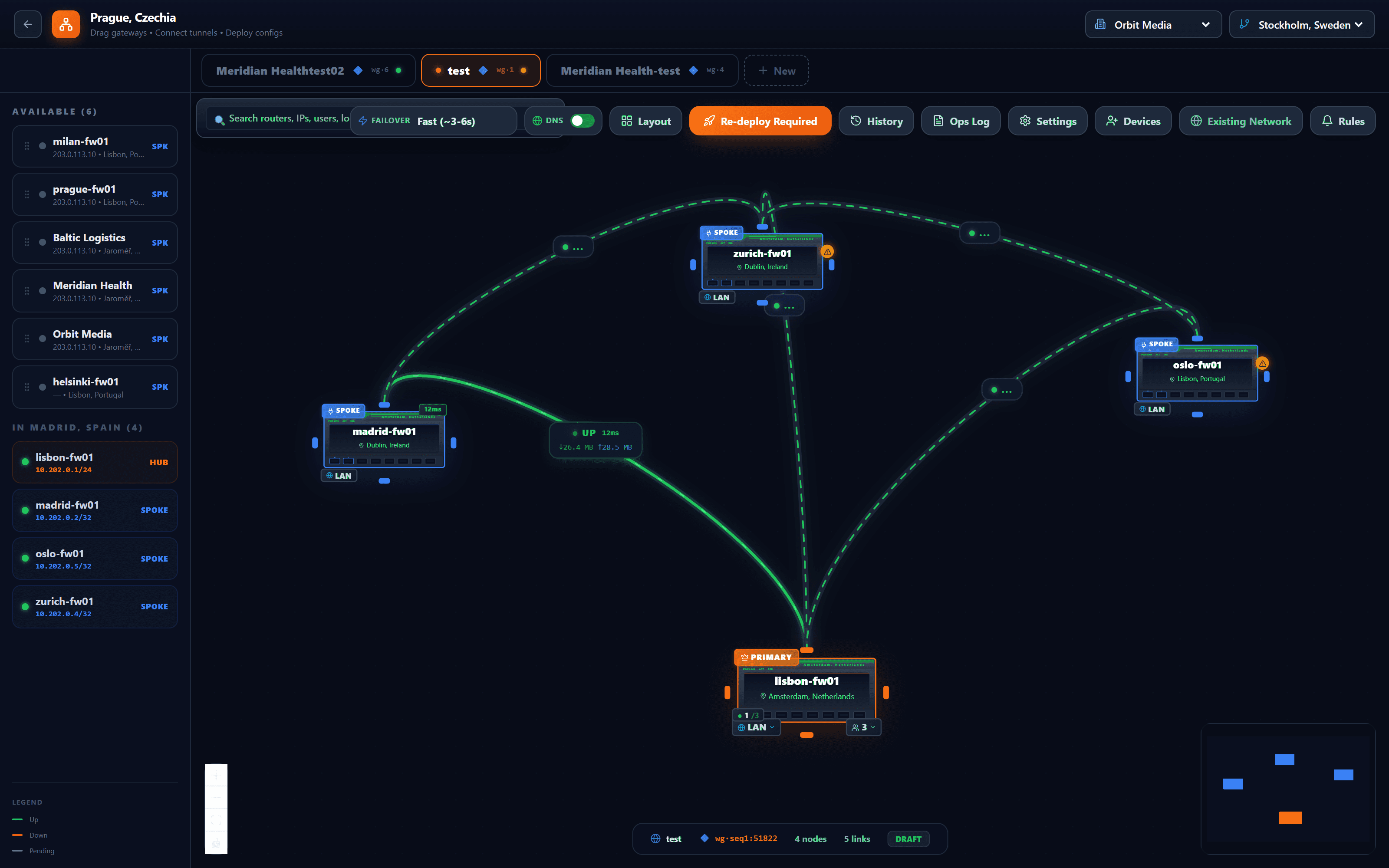
Adding a site is placing a node
Addressing, keys and routes are worked out for you. Each mesh gets a unique range, each node an address from it, and every peer's allowed routes are recomputed when the topology changes. Keys are generated on the firewall itself and only the public half is ever collected.
Three transports, chosen per topology
WireGuard for most deployments. OpenVPN where a certificate-based estate is already the standard and the operations team knows it. GRE where the transport is already private and you want routing without a second layer of encryption. The console tells you what each choice means before you commit to it.
Build a second hub, and keep the sites up
A backup hub holds host-only routes while the primary is healthy, so it never quietly attracts traffic. When the primary stops answering, the console moves every spoke across — automatically once you enable it, or on your command with a preview of exactly what will change.
Per-application egress, and a fail-closed option
A rule selects traffic by application, category, TLS server name or domain, and names the uplink it should leave by: a second WAN, a WireGuard, OpenVPN or GRE tunnel, or an ordinary interface. If that target is unhealthy the rule can fall back to another — or drop, so a flow that must only ever traverse the tunnel does not quietly leave over the open WAN instead.
Links are scored, not just pinged
Every candidate uplink is probed on a five-second cycle over ICMP, DNS or HTTP, and scored on packet loss, latency and jitter across a rolling window. A tunnel is judged by whether its handshake is current, not by whether the interface exists. Hysteresis keeps a borderline link from flapping.